The Panackelty playground lets you try real programs without installing the native toolchain. Your code is compiled and run in your browser; the page doesn't send your source to a server.
Behind the editor, the browser runs Panackelty's compiler and virtual machine. The browser edition gives programs a smaller set of host features than the native toolchain.
A real compiler, running in your browser
When you press Run program, the page starts a worker, a background task that lets the editor stay responsive while your program runs. The worker loads Panackelty's compiler and standard library, along with the Panackelty virtual machine (VM). The VM executes Panackelty bytecode. For the browser, the VM is compiled to WebAssembly, a format browsers can run.
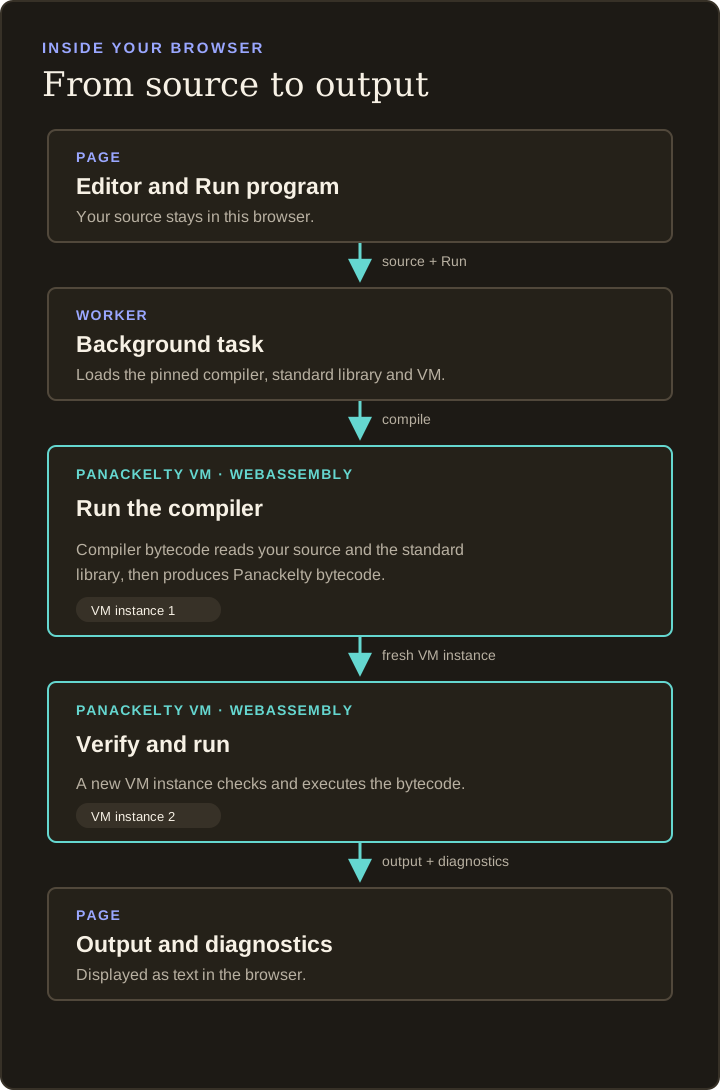
The compiler itself is written in Panackelty and runs in the VM.
JavaScript connects the editor, worker and WebAssembly module. It doesn't reimplement Panackelty's compiler or language rules.
Host access is limited. Panackelty programs can't read files on your device, write runtime files, start processes or open network connections. Standard input is empty, and native services such as file operations and sleep aren't available.
Each run starts fresh
The compiler needs files while it works: its own bytecode, the standard library, your source and the bytecode it produces. A temporary filesystem holds them for that run and is discarded when it ends.
The playground isn't a persistent REPL. It doesn't remember your program, so copy any code you want to keep. Loading another example replaces the editor's contents.
Runs are bounded
Runs have practical limits: source and combined output are each limited to 32 KiB, compiled bytecode to 1 MiB, the VM stack to 2 MiB and each VM instance to 256 MiB of WebAssembly memory. A foreground run is stopped after 15 seconds.
The browser itself uses additional memory, and it may delay timers when the page is in the background. These limits aren't a security certification or a cap on all memory used by the browser tab.
Pressing Stop terminates the worker for that run. Completion, errors and the time limit also end it. Replies from an ended worker are ignored, so old output can't replace the result of a later run.
The browser edition has its own release
The browser-specific build is maintained in the separate Panackelty Browser project. The website pins a particular browser release and checks its digest before assembling it. That pin is separate from the native toolchain, so a new native release doesn't automatically change the compiler or host features in the playground. The notice on the page tells you which native compiler release the browser edition is based on.
Try it in the Panackelty playground. The browser project's contract and limitations describe the implementation and its exact bounds.